
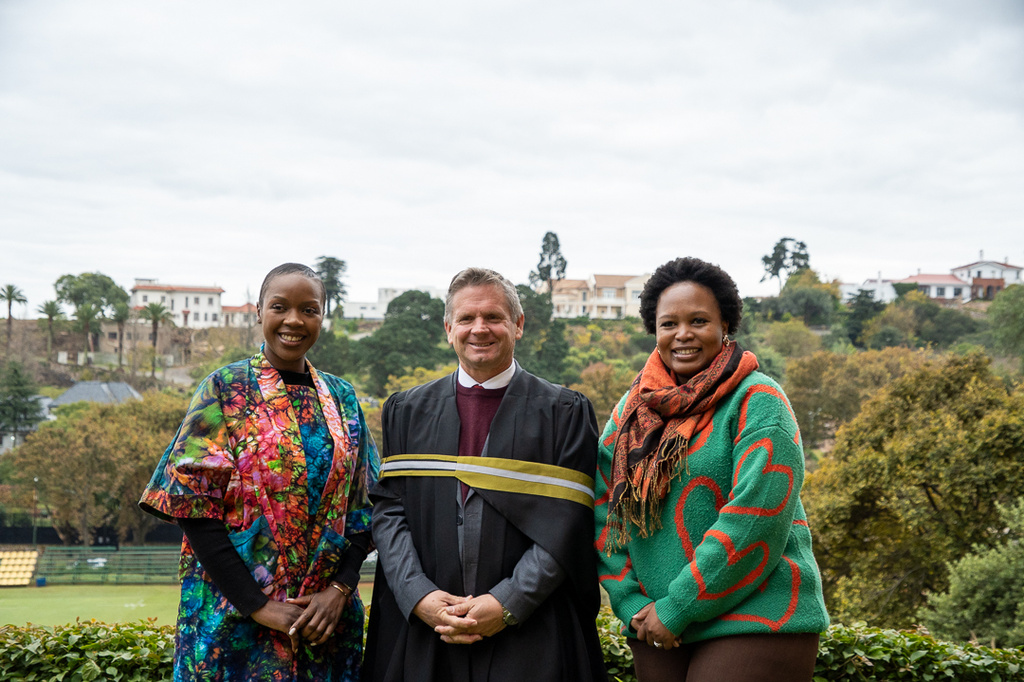
Ms Nyiko Khoza, speaker, moderator and Programme Head at the African Union Development Agency, addressed the students of St John's College for Africa Day, challenging them to reject narrow narratives about the continent and recognise Africa as a place of innovation and possibility, and their own role in shaping its future.
"On the one side is the Africa that is often presented to the world, a continent that is waiting to be rescued, a continent that is defined only through crisis, through poverty, instability, and dependency. And for the most part, that narrative still exists. But on the other side, I have the extraordinary privilege of working within this very African Union system. And from that vantage point, I see a very different Africa. I see an Africa that is moving. I see an Africa that is vigorously negotiating its place in the world. I see an Africa that is building, an Africa that is innovating, and an Africa that is creating. I see Africans who are not waiting to be saved or rescued, but are taking things into their own hands.
Africa is the youngest continent in the world. The average age across Africa is 19 years, and nearly 60% of Africa's population is under the age of 25. And by the year 2051, every 4 people on earth will be African. Which means that every single one of you sitting here is part of one of the most important demographic shifts in human history. Now let that sink in. These indeed are impressive and significant statistics. But these statistics mean nothing unless they are matched by vision, by leadership, by opportunity, and by responsibility.
And that is why, more than 60 years after 1963, we must ask ourselves an important question. What should Africa Day mean to us? In one era, the African project was centred primarily around political liberation and independence. But today, the questions we should be asking ourselves are much broader. How does Africa begin to build industries that thrive? How does Africa compete globally? How does Africa create jobs for young people? How does Africa tell its own stories? And how does Africa move from the immense potential that it has to actual power?
Some of Africa's biggest exports to the world are not only our minerals and our resources. They are our culture, our music, our fashion, film, sport, dance, storytelling. African artists are influencing international runways, athletes are dominating world stages, and African stories are reaching global audiences. What we are witnessing is Africans who are increasingly defining themselves on their own terms. And what excites me most about that is that many of the people driving this transformation are young, not much older than you sitting here this morning.
Allow me then to leave you with five simple thoughts. Or perhaps five challenges, as young Africans, standing at the edge of a rapidly changing century.
Firstly, you need to be students of history. Know the names of those who came before you. Know the ideas that shape the continent. Know the sacrifices that build the freedoms that we now enjoy today, because a generation that is disconnected from its history can easily become disconnected from its responsibility. Read African writers, study African leaders, and engage African ideas critically and honestly.
Secondly, refuse small narratives about Africa. Refuse the idea that Africa is a place of lack, of crisis, of dependency. Yet, of course, we ought to speak honestly about our challenges, because if we do not, we can never adequately address them. But never become so consumed by problems that you lose the ability to imagine possibilities. Because every great transformation in history began with people who were capable of imagining differently.
Thirdly, pursue excellence. But let your excellence serve something much greater than yourself. Your education is not merely a personal advantage, but it is a responsibility. South Africa, Africa, and the world need young people who are intelligent, but also young people who are ethical, compassionate, courageous, and deeply grounded.
Number four, never underestimate the power of your gift. Some of you will go on to build businesses. Some of you will enter the field of scientific technology. Some of you will work in the public service. Some of you still will become artists, athletes, filmmakers, musicians, storytellers, but never allow anyone to convince you that creativity is insignificant, because culture shapes economies, stories shape nations, and art shapes imagination.
And finally, believe that Africa belongs to you too. Not only to presidents, not only to governments, not only to institutions, but to you as well. The continent is not something happening far away from you. You are already part of that history. The choices you make, the values you hold, and the ideas you pursue, and the courage with which you live your life will all shape the Africa that emerges in the decades ahead.
Africa is not waiting for the future. Africa is building it, and you are part of that story.
I say, thank you. Asante sana."
-- This is an edited extract from Ms Nyiko Khoza's address to St John's College on Africa Day, 22 May 2025.